Pricing
Podcast studio setup cost in India: four kits, every item priced
What it costs to set up a podcast in India, from a ₹16,524 solo microphone kit to a three-camera studio, with every item priced at an Indian retailer and a build-or-rent comparison.
By the BookMyPodcastStudio team · Updated · 9 min read
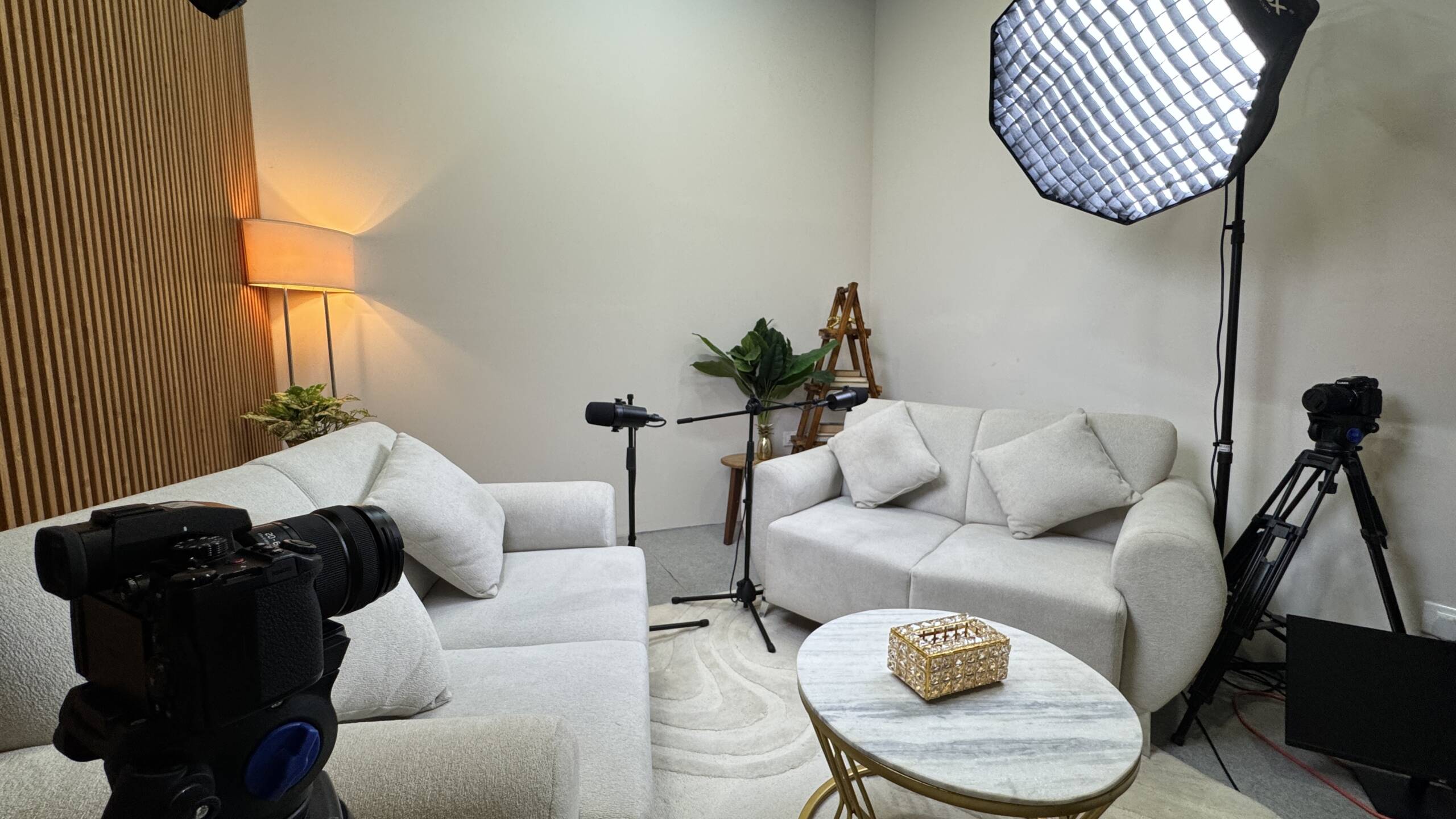
Setting up a podcast in India costs about ₹16,524 for one voice recorded at home, ₹67,821 for two people on separate microphones, ₹2.36 lakh to film two people with proper lighting, and around ₹6.97 lakh in equipment for a three-camera studio you could rent out. Those are four complete kits, every item priced at an Indian retailer on 19 October 2026. The room itself is the one thing they leave out: a home setup uses the room you have, and building a commercial room is quoted job by job.
What a podcast setup costs: four setups at a glance
Each kit is complete for its job, from the microphone to the memory card. Prices are what each retailer listed on 19 October 2026; they move, so treat them as a budget, not a quote.
Total equipment cost, by setup
Every item priced at an Indian retailer on 19 October 2026. The room, furniture and a computer are not included.
- One voice, audio₹16,524
- Two voices, audio₹67,821
- Two voices, video₹2,36,291
- Rental studio₹6,97,183
Kit 1: one voice, audio only
For a solo show recorded at a desk, two things do the work: a microphone and a pair of closed headphones. Choose a dynamic microphone rather than a condenser. A dynamic microphone hears what is a few centimetres in front of it and very little of the room, which is what you want in a bedroom or an office that was never built for sound. A condenser hears everything, including the fan and the traffic.
| Item | Qty | Cost | What it is for |
|---|---|---|---|
| Samson Q2U | 1 | ₹9,034 | Dynamic microphone with both USB and XLR outputs; desktop stand included |
| Sony MDR-7506 | 1 | ₹7,490 | Closed-back headphones, so the microphones do not pick up what you hear |
| Total | ₹16,524 |
The Samson Q2U has both a USB output, which goes straight into a laptop, and an XLR output, which goes into a recorder or mixer. Start on USB; if you add a co-host later, the same microphone moves to a recorder with no waste. It comes with a desktop stand, so nothing else is needed to start. Record and edit in free software (see software), and the kit is complete.
Kit 2: two people, audio only
The common mistake with two people is two USB microphones into one laptop, or one microphone between both. Neither gives you what makes a conversation editable: each voice on its own track, so a cough, a laugh or a level that drifts can be fixed on one person without touching the other. A dedicated recorder does this, and it also gives each person their own headphones and volume.
| Item | Qty | Cost | What it is for |
|---|---|---|---|
| Zoom PodTrak P4 | 1 | ₹18,999 | Recorder with four microphone inputs and four headphone outputs; each voice on its own track |
| Samson Q2U | 2 | ₹18,068 | Dynamic microphone with both USB and XLR outputs; desktop stand included |
| Sony MDR-7506 | 2 | ₹14,980 | Closed-back headphones, so the microphones do not pick up what you hear |
| XLR cable, 3 m | 2 | ₹998 | Connects a microphone to the recorder |
| SanDisk Extreme Pro 64GB SD card | 1 | ₹2,800 | Storage for the recorder |
| Acoustic foam tile, 1 × 1 ft, 2 in thick | 24 | ₹11,976 | Absorbs echo around the microphones |
| Total | ₹67,821 |
The Zoom PodTrak P4 takes four microphones, has four headphone outputs and records each input to its own file on an SD card, so the same box covers a guest or two later. The 24 foam tiles cover about 24 square feet of wall behind and beside the speakers, which is enough to take the hard edge off a small room’s echo. They are optional if you record in a room with a carpet, curtains and a full bookshelf.
Kit 3: two people on video
Video adds three things to kit 2: a camera, something to hold it, and light. Spend on the light first. A face lit evenly from the front by a large soft source looks professional on a phone camera; a face lit by a ceiling tube looks amateur on any camera. Two lights with softboxes, one angled at each speaker, is the standard two-person setup.
| Item | Qty | Cost | What it is for |
|---|---|---|---|
| Everything in kit 2 | ₹67,821 | ||
| Sony ZV-E10 II with 16–50mm lens | 1 | ₹98,250 | Mirrorless camera for the wide shot |
| SanDisk Extreme PRO 128GB SD card | 1 | ₹5,360 | Storage for the camera |
| Joby Compact Tripod Kit | 3 | ₹10,800 | Holds a camera or a phone at up to 1.3 m |
| Aputure Amaran COB 60x S | 2 | ₹41,980 | Bi-colour LED light with a Bowens mount |
| Godox EazyFlow 60 × 90 cm softbox | 2 | ₹10,380 | Spreads the light so faces are not harsh; Bowens mount |
| DigiTek 9 ft light stand | 2 | ₹1,700 | Holds a light and its softbox |
| Total | ₹2,36,291 |
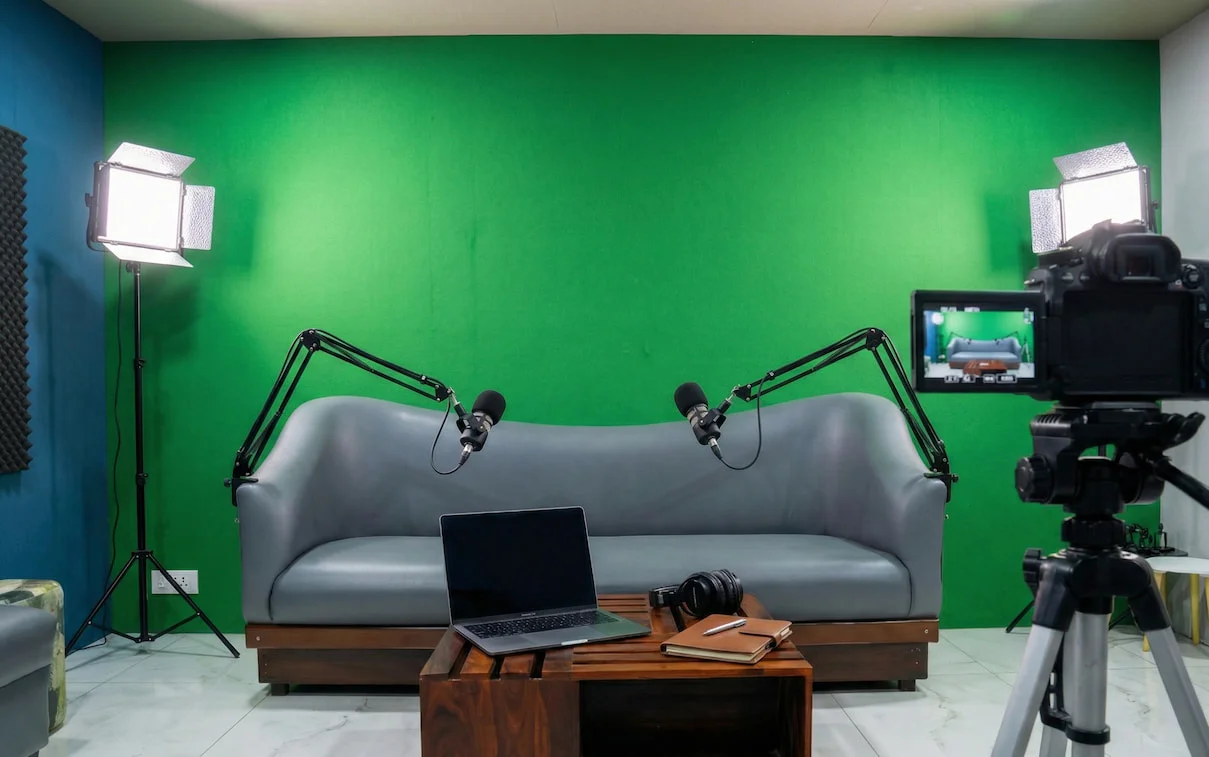
The camera records the wide shot of both people. For the close-ups, put your phones on the other two tripods: a recent phone filming a well-lit face is good enough for most podcasts, and a second or third mirrorless camera adds ₹1,03,610 each. The Joby tripods hold a camera or a phone (a phone needs a clamp, sold separately). Record sound on the PodTrak, not the cameras, and line the two up in the edit.
Kit 4: a small studio to rent out
A studio that charges for bookings needs to seat up to four people, film them from three angles and hand over clean, separate tracks every time, without anyone fiddling with cables. That means a mixer with a control for each microphone, a microphone on an arm for every seat, three matched cameras and three lights.
| Item | Qty | Cost | What it is for |
|---|---|---|---|
| Rode RØDECaster Pro II | 1 | ₹88,999 | Mixer and multitrack recorder with four microphone inputs and four headphone outputs |
| Samson Q9U | 4 | ₹88,000 | Broadcast dynamic microphone, USB and XLR |
| Rode PSA1+ boom arm | 4 | ₹61,556 | Holds a microphone off the table, in front of the speaker |
| Sony MDR-7506 | 4 | ₹29,960 | Closed-back headphones, so the microphones do not pick up what you hear |
| XLR cable, 3 m | 4 | ₹1,996 | Connects a microphone to the recorder |
| Sony ZV-E10 II with 16–50mm lens | 3 | ₹2,94,750 | Mirrorless camera for the wide shot |
| SanDisk Extreme PRO 128GB SD card | 3 | ₹16,080 | Storage for the camera |
| Joby Compact Tripod Kit | 3 | ₹10,800 | Holds a camera or a phone at up to 1.3 m |
| Aputure Amaran COB 60x S | 3 | ₹62,970 | Bi-colour LED light with a Bowens mount |
| Godox EazyFlow 60 × 90 cm softbox | 3 | ₹15,570 | Spreads the light so faces are not harsh; Bowens mount |
| DigiTek 9 ft light stand | 3 | ₹2,550 | Holds a light and its softbox |
| Acoustic foam tile, 1 × 1 ft, 2 in thick | 48 | ₹23,952 | Absorbs echo around the microphones |
| Total | ₹6,97,183 |
That is ₹6.97 lakh of equipment, and it is the smaller part of the bill. It leaves out the room: sound insulation, a second door, air conditioning quiet enough to leave on, furniture, a set, and the rent or the property. Those are quoted per job and vary too much from city to city to price here; get at least three quotes from contractors who have built studios before, and ask to visit one.
Acoustic foam is not soundproofing
Two different problems get called “soundproofing”. Echo is your own voice bouncing off bare walls, and it is what makes a home recording sound like a bathroom. Foam, curtains, rugs and bookshelves absorb it, cheaply. Noise is sound coming in from outside: traffic, a pressure cooker, the neighbour’s drill. Foam does almost nothing about it; only mass and sealed gaps do, which means construction.
For a home setup, that makes the choice of room the biggest decision you make, and it is free: the smallest, softest, quietest room you have, away from the road, at the quietest time of day. Treat the wall behind and beside each speaker for echo, use dynamic microphones, and most of the problem is solved before the foam arrives.
Software and running costs
- Recording and editing audio: Audacity is free, and is enough to cut and level an audio episode.
- Editing video: DaVinci Resolve has a free version that handles multi-camera editing; Blackmagic Design sells the paid Studio version for advanced features. Adobe Premiere costs ₹733.96 a month on an annual plan, with a first-year offer of ₹389 a month including GST when we checked.
- Publishing: free. Spotify for Creators hosts a show at no charge, lists it on Spotify and gives you a feed to submit to the other apps; the guide to starting a podcast walks through it.
- Your time: the real running cost. Editing a one-hour conversation usually takes several hours when you are starting out. Studios charge for it for a reason: one published rate card prices an edited episode with four reels at ₹4,999 plus GST.
Build or rent: when owning a setup pays for itself
The typical published rate for a podcast studio on this site is ₹2,000 an hour, so a two-hour session costs about ₹4,000. At that rate, kit 1 costs the same as about 4 sessions and kit 2 about 17. For video, studios published ₹5,000 to ₹9,500 for a two-camera episode in October 2026, so kit 3 costs the same as 25 to 47 studio episodes.
That arithmetic flatters owning, because a studio also gives you a treated room, an operator, a set and someone else’s time setting up. Renting wins if you record a few times a year, if your guests expect a proper studio, if you do not have a quiet room, or if you are still testing whether the show will last. Owning wins once you will record well past those break-even numbers, say every week for a year, in a room you control.
Many shows do both: record weekly audio episodes at home and book a studio for the video episodes and the guests that matter most. To compare studios near you, start with podcast studios near you, and use the nine-point checklist to pick one.
Where to save and where not to
- Do not save on: a dynamic microphone for every speaker, a recorder that keeps their tracks separate, and lighting if you film. These are the things that cannot be fixed afterwards.
- Save on: the camera (start with phones for close-ups), stands and cables, and premium boom arms, which are a comfort rather than a sound improvement.
- Buy once: microphones and headphones last for years. A microphone with both USB and XLR outputs moves with you from a laptop to a recorder.
- Keep the bill: buy from an authorised seller with a GST invoice; the Indian warranty depends on it.
Where the prices come from
Every item was priced on 19 October 2026 at the retailer linked below, at the price shown on its site that day, before delivery. Prices change often and sales move them a long way, so compare two or three sellers before buying. The kits are examples of a sensible combination, not endorsements; this site is not paid by any brand or shop named here. The studio rates in the build-or-rent comparison are the published rates on this site’s listings.
- Samson Q2U: ₹9,034 at Bajaao
- Sony MDR-7506: ₹7,490 at Headphone Zone
- Zoom PodTrak P4: ₹18,999 at Bajaao
- XLR cable, 3 m: ₹499 at Bajaao
- SanDisk Extreme Pro 64GB SD card: ₹2,800 at Foto Centre India
- Acoustic foam tile, 1 × 1 ft, 2 in thick: ₹499 at Bajaao
- Sony ZV-E10 II with 16–50mm lens: ₹98,250 at Foto Centre India
- SanDisk Extreme PRO 128GB SD card: ₹5,360 at Foto Centre India
- Joby Compact Tripod Kit: ₹3,600 at Foto Centre India
- Aputure Amaran COB 60x S: ₹20,990 at Foto Centre India
- Godox EazyFlow 60 × 90 cm softbox: ₹5,190 at Foto Centre India
- DigiTek 9 ft light stand: ₹850 at Foto Centre India
- Rode RØDECaster Pro II: ₹88,999 at Bajaao
- Samson Q9U: ₹22,000 at Bajaao
- Rode PSA1+ boom arm: ₹15,389 at Bajaao
Frequently asked questions
How much does it cost to set up a podcast studio in India?
About ₹16,524 for one voice recorded at home, ₹67,821 for two people on separate microphones, ₹2.36 lakh to film two people with proper lighting, and around ₹6.97 lakh in equipment for a three-camera studio you could rent out, on retailer prices checked on 19 October 2026. Building the room itself for a commercial studio is extra and quoted per job.
What is the minimum equipment needed to start a podcast?
A dynamic microphone and a pair of closed headphones, about ₹16,524 together, plus free editing software such as Audacity. A dynamic microphone matters more than an expensive one: it picks up your voice and little of the room.
Is it cheaper to build a podcast setup or rent a studio?
It depends on how often you record. A two-person audio kit costs ₹67,821, the same as about 17 two-hour studio sessions at the typical published rate of ₹2,000 an hour. If the show will need fewer sessions than that, or you need a treated room and an operator, renting is cheaper.
Should I buy a USB or an XLR microphone?
A microphone with both, such as the Samson Q2U. USB plugs straight into a laptop for a solo show; XLR goes into a recorder or mixer when you add people. With both on one microphone, nothing is wasted when the show grows.
Does acoustic foam soundproof a room?
No. Foam absorbs echo inside the room, which is what makes home recordings sound hollow. It does almost nothing to stop noise from outside, such as traffic; that takes construction. Choose the quietest room first, then treat it for echo.
How much does it cost to build a professional podcast studio?
The equipment for a three-camera, four-microphone studio comes to about ₹6.97 lakh at 19 October 2026 prices. The room is extra: insulation, doors, quiet air conditioning, furniture and the rent or property, which contractors quote per job.